
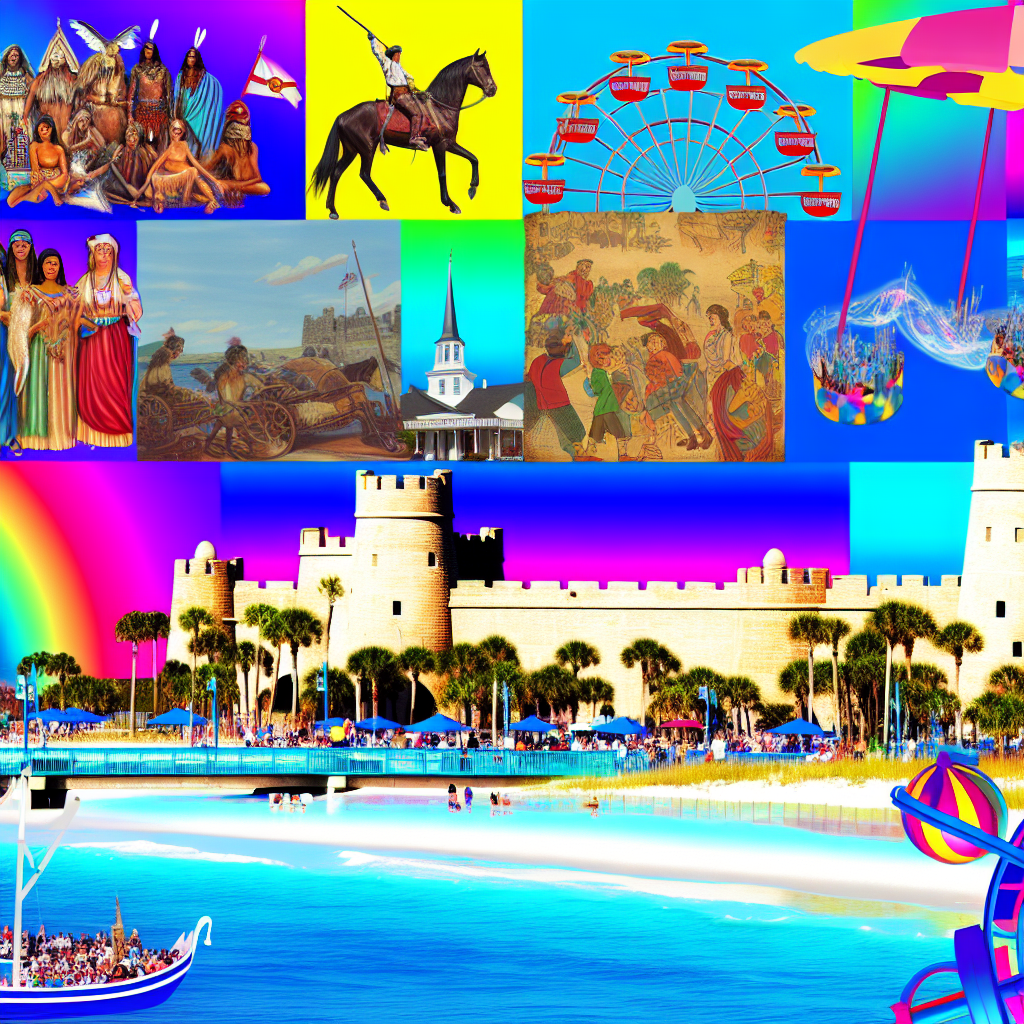
The History of Florida is a captivating tale that reveals the state’s journey from its indigenous roots to its emergence as a premier tourist destination. Long before European explorers set foot on its shores, Florida was home to diverse Native American cultures, each contributing to the rich tapestry of the region. The arrival of European explorers in Florida, such as Juan Ponce de León and Hernando de Soto, marked a pivotal shift in its narrative, leading to the establishment of missions and settlements that laid the groundwork for Florida colonial history. This complex past continued to evolve through significant events like the Civil War, which greatly impacted Florida’s development and identity. Today, as we delve into St. Augustine history and other significant milestones, we can appreciate how Florida has transformed while celebrating its vibrant heritage.
Exploring the historical progression of the Sunshine State unveils a narrative that spans centuries, from the early days of indigenous settlements to modern tourism. The deep-rooted Native American tribes once thrived here, setting the stage for later encounters with European pioneers. As Florida colonial history unfolded, it experienced a myriad of influences, including conflicts and cultural exchanges that shaped its identity. Meanwhile, moments from the Civil War Florida era echo in the landscapes and narratives of its cities today. Understanding this evolution offers a profound insight into the vibrant state history and the factors that draw millions to its shores each year.
The Rich Tapestry of Native American Cultures in Florida
Florida’s history began long before European contact with the flourishing of diverse Native American cultures. Tribes such as the Timucua, Apalachee, and Calusa thrived in different regions, each exhibiting unique societal structures and habits. The Timucua, known for their agriculture and sophisticated pottery, formed complex chiefdoms in northeast and north-central Florida. Their vibrant communities functioned through trade and cooperation, showcasing the interconnectivity of their cultures and practices.
Similarly, the Apalachee tribe, predominantly found in the panhandle, thrived on robust agricultural practices, cultivating crops like maize that sustained their growing populations. They complemented farming with fishing and hunting, creating a balanced lifestyle. The Calusa, whose territory ranged along Florida’s southwestern coast, uniquely depended on the abundant marine life of the Gulf of Mexico rather than agricultural societies. Their rich cultural practices contributed to the diverse heritage that forms the foundation of modern Florida.
Exploring the Era of European Explorers in Florida
The arrival of European explorers marked a significant turning point in Florida’s history. In 1513, Juan Ponce de León’s expedition heralded a new era of exploration and colonization. His misconceptions about finding gold led to the establishment of Spanish interests in the region. Following Ponce de León, Hernando de Soto’s journeys through Florida revealed the potential for wealth, and while they sought treasures, their expeditions brought devastating consequences for the Native American tribes due to introduced diseases and conflicts.
This wave of exploration set the stage for the establishment of St. Augustine in 1565 by Pedro Menéndez de Avilés, which became the first colony in the United States. The cultural impacts of these early explorations are still evident today, as they laid the groundwork for centuries of Spanish influence that transformed Florida’s cultural landscape, architecture, and societal norms.
Colonial Conflicts and the Evolution of Florida’s Colonial Era
The Colonial Era of Florida is characterized by a tumultuous history of power struggles between the Spanish and British empires. The Treaty of Paris in 1763 was a pivotal moment when Great Britain formally took control of Florida, dividing it into East and West Florida. This shift altered the state’s demographic landscape, with an influx of British settlers establishing plantations and utilizing enslaved African Americans for labor. The clash of cultures during this period created a dissonant yet rich societal tapestry.
After the American Revolutionary War, Florida returned to Spanish control in 1783, leading to further cultural intermingling. The ramifications of these transitions influenced not only governmental policies but also the daily life and cultural practices of Floridians. The eventual acquisition by the United States in 1821 and its statehood in 1845 marked the end of a colonial saga, but the influences of these varied cultures remain integral to Florida’s identity.
Florida and the Civil War: A Struggle for Identity
Florida’s involvement in the Civil War brought significant challenges due to its reliance on agriculture and social structure. The state seceded from the Union in 1861, aligning with the Confederacy. Despite its small population, Florida contributed troops and resources, with participation in key battles, which deeply affected local communities and economies. The Civil War left deep scars but also a legacy of resilience as Floridians faced the harsh realities of conflict.
Post-war, Florida entered a challenging period of reconstruction, grappling with social upheaval and rebuilding efforts. The changes during this era forced many to reevaluate their roles in society. As Florida reintegrated into the United States, it reflected the nation’s broader struggle with identity, as former Confederates and newly freed African Americans navigated a rapidly changing landscape.
The Transformation into a Modern Tourist Destination
The late 19th and early 20th centuries were transformative for Florida as the arrival of the railroad catalyzed vigorous population growth. This infrastructure enabled more people to discover Florida’s temperate climate and natural beauty, allowing cities like Miami, Tampa, and Jacksonville to flourish as urban centers. The establishment of hotels and the promotion of Florida as a winter retreat illustrated how the state was pivoting toward a tourism-driven economy.
By the mid-20th century, the tourism sector exploded, particularly after major developments like Disney World opened in 1971. Florida evolved into a global tourism hub, attracting millions with its theme parks, beaches, and cultural attractions. This shift not only altered the state’s economic landscape but also ushered in a new era of diversity as Florida became a melting pot of cultures, further enhancing its appeal as a premier travel destination.
Frequently Asked Questions
What Native American cultures existed in the history of Florida?
Before European contact, Florida was home to several Native American cultures, notably the Timucua, Apalachee, and Calusa tribes. Each tribe had its unique lifestyle, practices, and social structures. The Timucua lived in the northeast, while the Apalachee thrived in the panhandle area, and the Calusa resided along the southwestern coast, relying heavily on the abundant marine resources.
Who were the key European explorers in the history of Florida?
The history of Florida includes prominent European explorers such as Juan Ponce de León, who was the first to land in 1513 and named it ‘La Florida.’ Hernando de Soto followed, exploring further in search of wealth. These explorations began a period of significant change for the indigenous populations due to the introduction of disease and European settlement.
How did Florida’s colonial history shape its development?
Florida’s colonial history began with Spanish and later British control, which saw the establishment of missions and plantations. The Treaty of Paris (1763) ceded Florida to Britain, resulting in two separate colonies. Its return to Spanish control in 1783 and eventual transfer to the U.S. in 1819 shaped Florida into a diverse state with a mix of European and indigenous influences, ultimately achieving statehood in 1845.
What was the significance of St. Augustine in Florida’s history?
St. Augustine, founded in 1565 by Pedro Menéndez de Avilés, holds the title of the oldest continuously inhabited European settlement in the continental United States. Its history reflects the cultural exchanges between Spanish settlers and Native Americans, influencing Florida’s architectural and social development throughout the centuries.
How did the Civil War impact Florida’s state history?
Florida’s state history during the Civil War was marked by its secession from the Union in 1861 and subsequent joining of the Confederacy. The war had profound economic and social impacts, leading to challenges in reconstruction. Post-war, Florida underwent significant changes as it reintegrated into the nation, setting the stage for modern development and tourism.
| Era | Key Points |
|---|---|
| Native American Cultures | Home to diverse tribes like Timucua, Apalachee, and Calusa, each with unique cultures. |
| European Exploration (1513 – 17th century) | Ponce de León’s landing in 1513; introduction of diseases and missions. |
| Colonial Era (1763 – 1819) | Transition between Spanish and British control, establishment of plantations, and diverse cultures. |
| Civil War (1861 – 1865) | Florida seceded, faced devastation from the war, leading to reconstruction. |
| Birth of Modern Florida (late 19th century) | Railroad expansion leads to population growth and tourism development. |
| Post-War Era to Present | Increased tourism, Disney World opened in 1971, diverse economic growth. |
Summary
The history of Florida is a fascinating narrative that unfolds chronologically, starting from its rich Native cultures, transitioning through European exploration in 1513 led by Ponce de León, and evolving through the colonial era marked by struggles between Spain and Britain. The Civil War brought significant changes, followed by the birth of modern Florida driven by the railroad and subsequent tourism boom. Today, following the post-war expansion and the introduction of major attractions, Florida stands as a vibrant state with a dynamic economy and a rich cultural heritage.